How Far Must a Wood Mantel Shelf Be Above the Fireplace Opening (NFPA Code)?
Determining how far must a wood mantel shelf be above the fireplace opening (NFPA Code) is a critical safety step for any homeowner planning a living room renovation. While design trends often push for lower, modern profiles, the physics of heat radiation demands strict adherence to safety standards. Understanding these clearance requirements protects your home from the risk of combustion caused by rising temperatures.
This information helps you balance aesthetic goals with the non-negotiable reality of fire safety, ensuring your fireplace remains a warm centerpiece rather than a household hazard. By following these established guidelines, you can confidently plan your mantel installation while maintaining compliance with national fire standards.
The Standard Clearance Requirement

If you are wondering how far must a wood mantel shelf be above the fireplace opening (NFPA Code), the answer often begins with the manufacturer’s instructions. For factory-built fireplaces, the specific installation manual is the ultimate authority.
These documents provide precise measurements for clearances based on rigorous heat testing conducted during the product’s certification process. Ignoring these instructions for the sake of a specific look can void your warranty and, more importantly, create a dangerous situation.
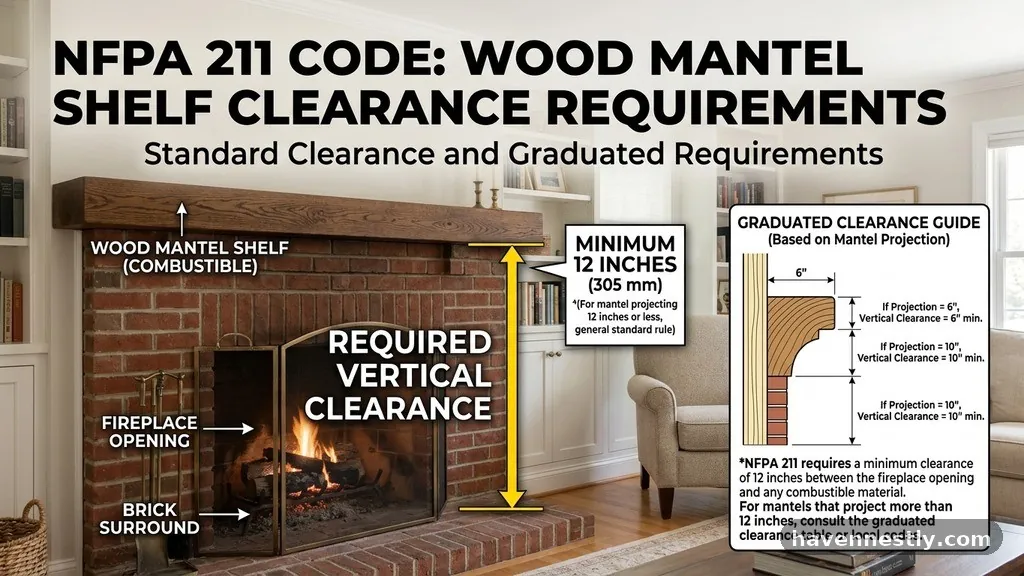
For traditional masonry fireplaces, the National Fire Protection Association (NFPA) provides a baseline standard. NFPA 211, the Standard for Chimneys, Fireplaces, Vents, and Solid Fuel-Burning Appliances, dictates that combustible materials—including wood mantels—must be kept at a safe distance from the firebox.
A common rule of thumb is that for every 1/8 inch of projection the mantel extends from the wall, it should be at least 1 inch higher than the top of the fireplace opening. This ratio is a foundational concept in fire safety design.
Understanding the NFPA 211 Guidelines
The NFPA does not provide a single, universal “inch” measurement for all installations because every fireplace setup behaves differently. Instead, the code focuses on the thermal impact on surrounding materials.
Wood is a combustible material, and it will eventually pyrolyze—a process where it breaks down chemically due to heat—if exposed to high temperatures over time. Even if a mantel does not catch fire immediately, slow degradation can eventually lead to ignition.
You must look at the specific construction of your fireplace unit to determine which rules apply. If you have a masonry fireplace, you are often looking at older, prescriptive building codes that may vary by local jurisdiction.
If you have a modern gas or prefab unit, the manufacturer’s manual will supersede general guidelines. Always prioritize the manual provided by the manufacturer, as it accounts for the specific heat output and venting characteristics of that exact model.
The Mathematics of Mantel Projection

The relationship between projection and height is the most common point of confusion for homeowners. When you ask how far must a wood mantel shelf be above the fireplace opening (NFPA Code), you are essentially asking about the geometry of heat dissipation.
As the mantel extends further into the room, it intercepts more of the rising heat plume from the firebox. Therefore, a deeper shelf requires a greater vertical distance from the fireplace opening to stay cool.
Consider the following table as a general reference for how projection affects required height. Note that these are generalized estimates; always verify against your local building department’s specific requirements.
| Mantel Projection (Inches) | Minimum Height Above Opening (Inches) |
|---|---|
| 1 inch | 6 inches |
| 3 inches | 8 inches |
| 6 inches | 12 inches |
| 8 inches | 16 inches |
| 12 inches | 24 inches |
Why Wood Requires Special Attention
Wood mantels are popular because they add warmth and character, but they are inherently flammable. Unlike stone or marble, which are non-combustible and can often be placed closer to the firebox, wood requires significant air gaps to prevent charring.
Even treated or fire-resistant wood can still be damaged by prolonged heat exposure. The goal of the clearance is to ensure the surface temperature of the wood stays well below the ignition threshold.
Heat travels in two ways: through convection as hot air rises, and through radiation as infrared energy moves outward. A mantel shelf acts as a shelf for this rising hot air, trapping it against the wall above the fireplace.
This is why the area immediately above the firebox is the most dangerous zone. Placing objects or combustible materials here without proper clearance is a leading cause of accidental chimney-related fires.
Local Codes and Building Inspections
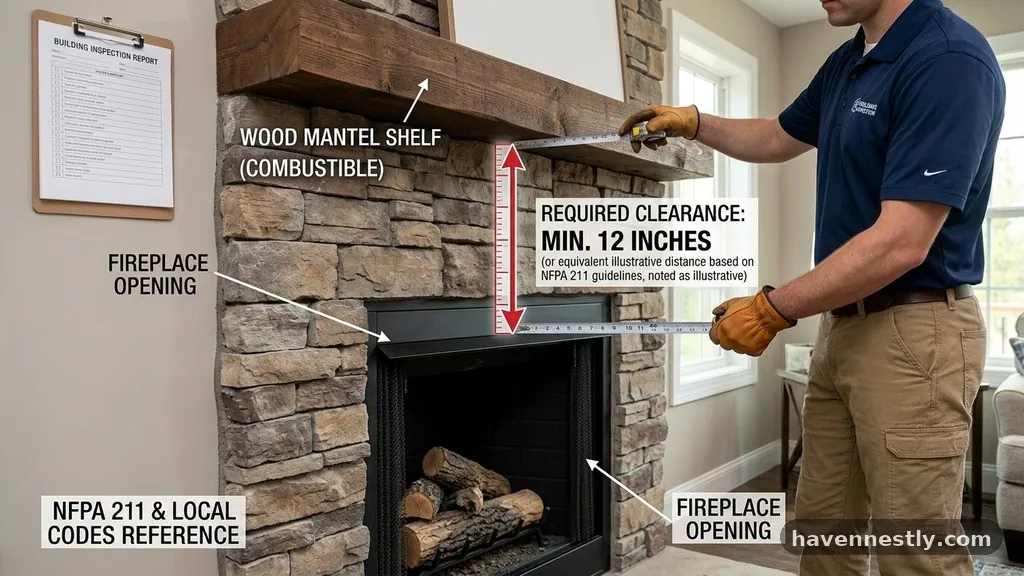
While NFPA standards provide the framework, your local building codes are what matter for inspections and insurance. Many municipalities adopt the International Residential Code (IRC), which often references NFPA 211.
However, some local jurisdictions add their own amendments. A local fire marshal or building inspector has the final say on whether your installation is acceptable during a home sale or renovation permit process.
Before you begin installing a new mantel, check with your local building office. They can tell you if there are specific regional requirements for fireplaces in your area.
They might require a specific type of mounting hardware that is fire-rated, or they may demand that you use non-combustible backing materials between the wood and the wall. Skipping this step can lead to expensive rework if an inspector flags your installation as non-compliant.
The Role of Non-Combustible Materials
If you find that your design vision requires a wood mantel to be closer to the fireplace than the standard allows, consider using non-combustible materials to bridge the gap. You can install a stone or tile surround that extends upward, effectively moving the “combustible zone” higher.
This is a common design strategy in modern homes. By using marble or brick to create a barrier, you can safely mount a wood shelf lower than you otherwise could.
This approach involves installing a heat-shielding material that does not conduct heat as readily as wood. It creates a thermal break that protects the wood from the direct path of the firebox heat.
Be aware that even with a stone shield, you must still ensure that the mounting brackets for the wood shelf are properly anchored. The heat will still transfer through the stone, so the wood should never touch the firebox directly.
Common Mistakes in Mantel Installation
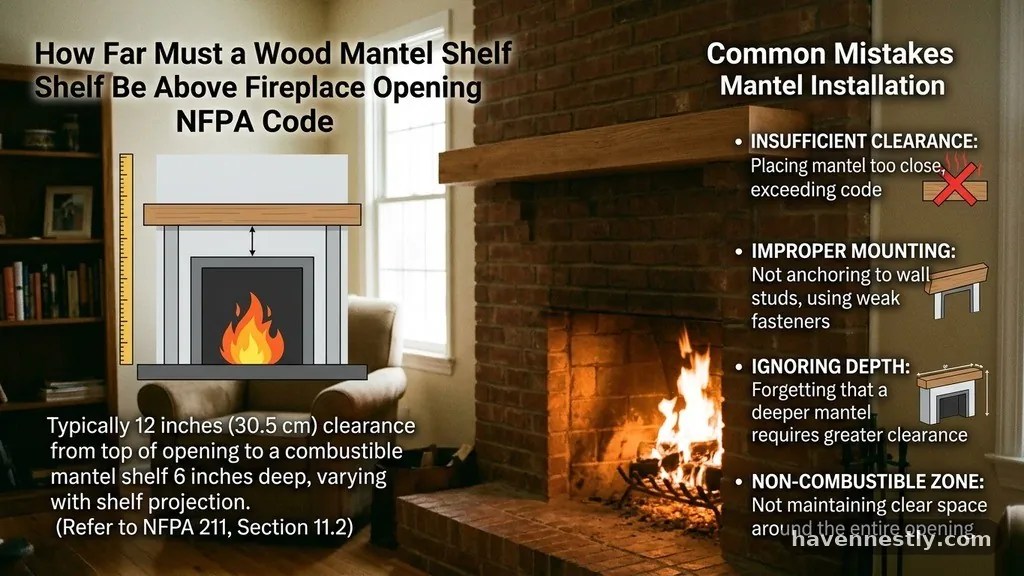
One of the most frequent errors is assuming that a mantel is “far enough” just because it looks balanced. Aesthetic proportion often conflicts with fire safety, and homeowners frequently choose beauty over clearance.
Another major mistake is ignoring the sides of the fireplace. The code applies to the sides of the opening as well, not just the top.
* Failing to check the manufacturer’s manual for gas inserts.
* Assuming all wood types have the same heat resistance.
* Mounting the mantel directly to the combustible studs without a heat shield.
* Neglecting to account for the depth of the mantel shelf.
* Mounting decorative items or electronics too close to the heat path.
Each of these mistakes can lead to the slow drying out of the wood, which increases the risk of combustion over time. Always verify your specific setup rather than relying on common “rules of thumb” found in home improvement forums.
Testing Your Setup for Safety
If you are concerned that your existing mantel is too close, you can perform a simple test. Use a reliable infrared thermometer to measure the temperature of the wood surface while the fireplace is at its peak output.
If the surface temperature exceeds 160 degrees Fahrenheit, you are approaching a danger zone. Most building codes aim to keep these surfaces significantly cooler to ensure a safety margin.
You can find more detailed safety guidelines and resources through the National Fire Protection Association website. Their resources provide extensive data on the behavior of fire in residential settings.
If you consistently see high temperatures, consider adding a metal heat deflector to the bottom edge of the mantel. This simple metal strip can redirect the hot air away from the wood and into the room, reducing the thermal load on the shelf.
Installing Safely with Gas Fireplaces

Gas fireplaces operate differently than wood-burning ones. They often feature glass fronts that radiate intense heat, and they may have specific venting requirements that create hot spots on the wall above the unit.
Because gas units are highly engineered, the manufacturer’s clearance requirements are non-negotiable. Many modern gas fireplaces have a “cool wall” technology that allows for mantels to be placed closer, but this only applies if the unit is explicitly rated for that installation.
Never assume that because your gas fireplace has a lower output than a wood-burning one, you can ignore the manuals. The convection currents in a gas fireplace can be surprisingly efficient at pushing heat directly onto a mantel.
Always verify the specific clearance requirements in the manual that came with your unit. If you have lost the manual, you can usually find it online by searching the model number located on the fireplace’s rating plate.
Maintenance and Long-Term Vigilance
Once a mantel is installed, your responsibility for fire safety does not end. Periodically check the wood for signs of damage, such as discoloration, cracking, or warping.
These are early warning signs that the wood is being subjected to excessive heat. If you notice these changes, it is a clear indicator that the mantel needs to be moved or that you need to install additional heat shielding.
Keep the area around the fireplace clear of clutter. Do not lean artwork or decorations against the wall near the fireplace opening.
Ensure that any nearby window treatments, such as curtains or blinds, are also well outside the clearance zone. A safe mantel installation is only as good as the environment around it, so maintain a clean and uncluttered zone to maximize your home’s safety.
Frequently Asked Questions
Does the type of wood matter for mantel clearance?
Yes, different species of wood have different ignition temperatures and densities. However, code requirements generally treat all wood as combustible, regardless of whether it is oak, pine, or mahogany. You should always adhere to the required distance regardless of the wood type.
Can I use a metal mantel to get closer to the opening?
Metal is non-combustible and can often be placed closer to the firebox than wood. However, metal conducts heat very efficiently. You must still be careful, as a metal mantel can become hot enough to burn someone who touches it or damage nearby wall materials.
What if my fireplace is a decorative electric model?
Electric fireplaces generally produce much less heat than gas or wood units. Check the manufacturer’s manual for your specific electric model, as they often have much smaller clearance requirements. Some can even be mounted directly against combustible materials, but you must confirm this with the documentation.
Are there height requirements for the sides of the fireplace?
Yes, clearance requirements apply to the sides of the fireplace opening as well. The code typically dictates that any combustible trim or mantel extension must be a certain distance from the sides of the firebox. Check your local code for these side-clearance measurements.
Does the finish on the wood affect safety?
Standard wood stains and polyurethane finishes are flammable and can release toxic fumes or ignite when heated. If you are mounting a mantel close to the heat zone, use high-heat-resistant finishes or keep the wood raw. Always ensure that any finish used is appropriate for a high-temperature environment.
Conclusion
Understanding how far must a wood mantel shelf be above the fireplace opening (NFPA Code) provides the peace of mind necessary to enjoy your home. By adhering to the manufacturer’s specifications and respecting the fundamental principles of heat dissipation, you protect your property from the risks associated with combustible materials. Always prioritize the manual that came with your fireplace, as it is the most accurate guide for your specific model.
If you are unsure about your current setup, consult with a professional chimney sweep or a local building inspector to verify that your home meets safety standards. Taking these proactive steps ensures that your fireplace remains a safe, warm, and inviting feature for years to come.